The key Fibonacci ratios are:

- 23.6%
- 38.2%
- 50.0%
- 61.8%
- 78.6%
- 88.6%
- 100%
- 127.0%
These percentages are used as major support / resistance values.
Fibonacci Retracements / Extensions
Retracements are basically profit taking and extensions are continuations onto the trend.
Drawing Fibonacci Lines
On an upward (bullish) trend, start the drawing at the bottom and then go up:
https://www.youtube.com/watch?v=QwJ-i5xJz8s#t=06m15s
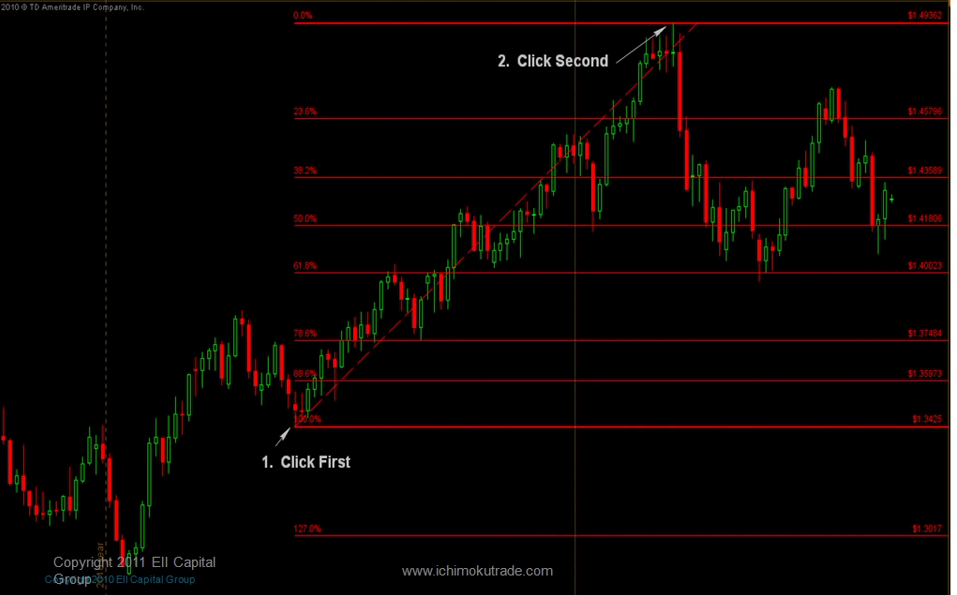
If you have only a 38.2% retracement, that is not a major pull back; it is not a major profit taking; you still have a major trend going up. They are “minor” profit taking.
If you are a Fibonacci trader, You never trade the 32.8% retracement. You need a major pull back to trade Fibonacci. At 38.2%, the reward/risk is not good. The money management is not good.
It needs to pull back drastically. The only ones you are going to trade are 50% or 61.8%; the “major” pull backs.
If the price goes beyond the 61.8% line, it means the institutions sold too much to the point where it will never go back and resume the trend, so the trend is over. 61.8% is the last line of defence.
Entries are retracements and extensions are where you take profits.
• Draw the Fibonacci Retracements from the beginning of the trend to the end of the trend.
• Look for the pull back (retracement) to 61.8%.
• Entry at the 61.8% retracement
• Stop a couple of points below the 61.8% retracement level or previous pivot
• Draw the Fibonacci Extensions from the end of the trend to the beginning
• Limit 1 at 88.6% Extension
• Limit 2 at 100% Extension
• Limit 3 at 128% Extension