Think of this as a mentoring lesson. You should spend at least an hour on reading, viewing, understanding and then email me with anything that is unclear. I’ve chosen a difficult trade – so don’t worry – you’re in at the deep end a little. We will do a lot more exercises till you get comfortable.
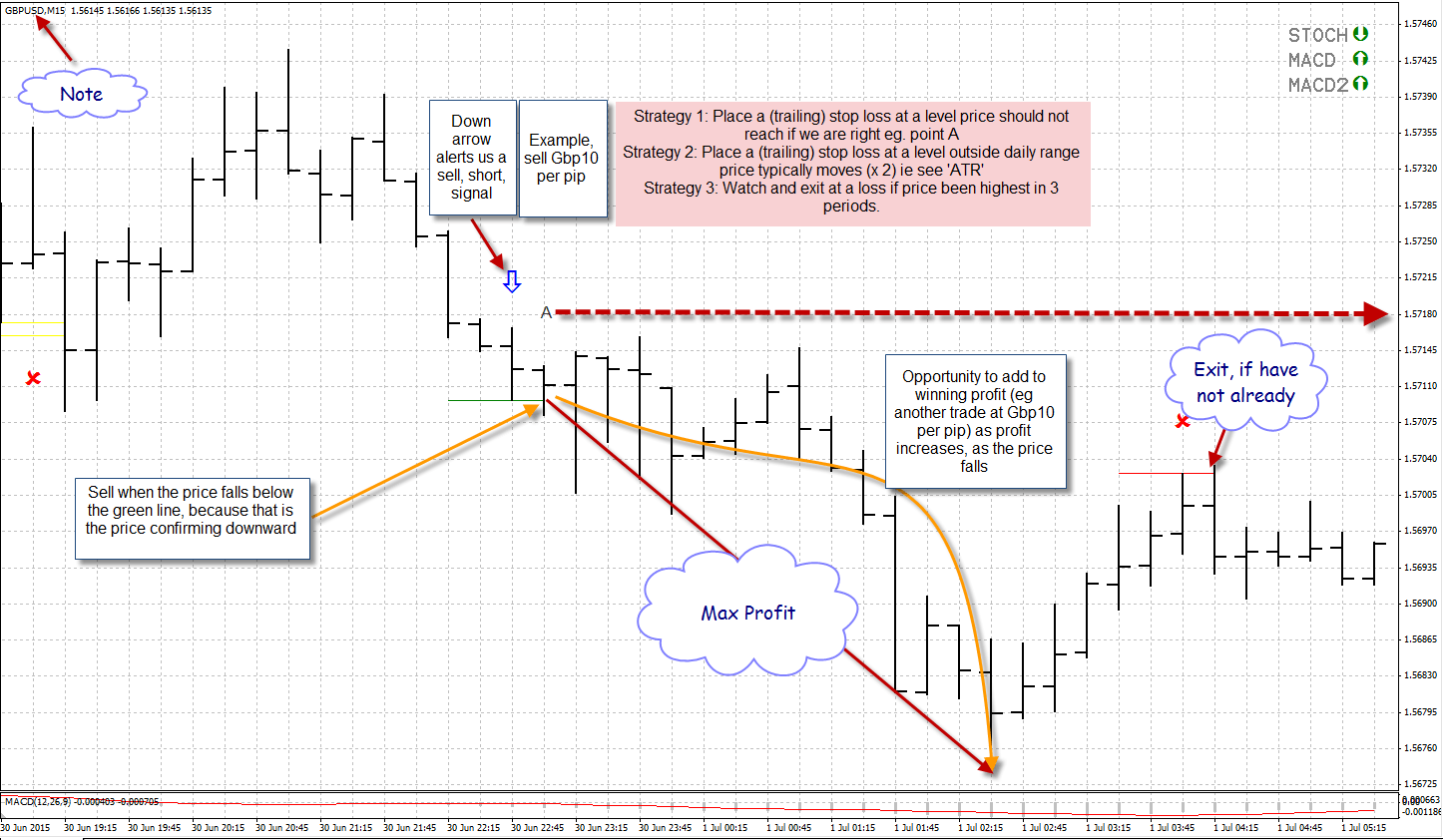
Look at the above image.
I want to mentor you through a difficult but typical trade. This is the kind of trade which is easier the more experienced you get. I also want to share some professional hedge fund manager tactics. This trade had the potential to make you a lot of money if you added additional positions and exited as the price started moving up, OR, it had the potential to make you a lot less if you exited too early and didn’t re-enter. So how does the experienced trader, handed this trade make so much more than the inexperienced one; and how do we mentor you to go from inexperienced to experienced?
- Trading is messy. We try to bring order to our trading onto messy markets. We want the price to move in one smooth direction, but that is not real life. We can’t wish what we want on the market. We have to trade at what the market throws at us.
- You can see where we have to go short. The great thing about the indicator is it puts the odds in our favour, and also tells us the direction we should be looking – removing getting in the wrong direction. That is a huge market help.
- So let’s then deal with the first problem in SELMMA – Stop Loss.
- We have several options with a stop loss.
- Strategy 1 – for the more experienced trader: ‘place a trailing stop at a level the price should not reach if we are right that it is likely to fall’. This strategy is also used for those who need to place a stop loss and walk away. Remember, you don’t have to place a stop loss if you are going to watch the screen, because you exit when the indicator tells you or strategy 2 or strategy 3 for stop loss – discussed elsewhere in my mentoring. This is a common professional hedge fund manager tactic.
- Strategy 1 come with experience. You get a feel for not putting the stop to close (else you are stopped too quickly), and not too far (else you lose too much). Most hedge fund managers would use this strategy, relying on their experience and intuition.
- Strategy 2 and 3 are discussed elsewhere – their downside is you are watching the market, but then you are a day trader, and that is fine, you watch.
- Now the next problem in SELMMA is taking profit, or limit order. Again your strategy depends on whether you need to leave your screen and be away, or will be watching.
- If you need to leave your screen then your limit order can be a reasonable likely level of profit based on projecting forward the downward trend, where the price has been recently if it has been at the same levels.
- If you do not need to leave your screen, then you can just exit when the indicator tells you, but you don’t let a profit to become a loss if the profit went more than 1% of your risk capital. eg if your risk capital was gbp10k, then 1% is gbp100. So if the position shows a profit of over gbp100 you would not want that to turn into a loss. Of course you wouldn’t want any profit to turn into a loss, but, we can’g just exit if a gbp 1 profit bobs around and becomes a gbp1 loss. You need a real proper profit eg 1% of your risk capital before you say, I will lock in my profits. Many traders, myself included, will not even wait that long; we may say even if 0.5% of our risk capital becomes profit, this will not be allowed then to become a losing trade.
- Sometimes I exit (or sell some of my position) if I see my profit erode, knowing I have no specific exit signal, but can always re-enter if it moves back lower. This is a common hedge fund professional practice.
- The next issue to solve is additional positions. You can only add more positions if the trade shows profits and you are there watching it of course. When do you add them. Well, I usually wait to see if my existing opening position made 1% profit of risk capital. But like I said, do not be a slave to the ‘rules’ – you may be feeling especially nervous, and want to add sooner. What about taking off these additional positions. I never want these to turn into losses, and I take them off pretty quickly if they’ve been in profit and then become losing. So I tend to add them when the price is quickly moving down.
As mentioned elsewhere before there are two types of trader. Those who need very rule based precision entry and exit, and those who are more discretionary and looking for a general reconfirmation of their views on the markets with the indicator. The job of the indicator is to put the odds more in your favour, to take you from 6 times right out of ten to seven.
I want the indicator to add to helping you in thinking more like a trader.
Strategies for Placing a Stop Loss from Alpesh Patel on Vimeo.
Stop Losses and Where to Place Them from Alpesh Patel on Vimeo.
I have had great apprentice Q&A on this:
Q: I started to try out adding to a position – it gives a good feeling to see those profits increasing. Do you do a full 1% to each additional position or take a smaller position?
A: Brilliant question. Due to experience, I tend to get a feel for the price and profits on the position and will add, and take off additional positions as I see the price moving quickly or slowly.
The reason I try to give rules to apprentices is that as they build their experience it helps for them to have some guidance. You see adding positions is about something very important in trading, that the world’s leading manager, and people like my trading mentors who managed the largest FX sums in the world knew – when you find a trend, a trade, in your favour, you max out that profit, that oil well – by adding to the positon.
Now how much and when do you add the additional position? For the experienced or the trader who prefers to feel price moves by examining them the answer is you add and subtract based on the speed and direction of the move.
But for the newbie or the more calculating, this is too difficult, for them I give rules. Like if the profit on the existing position is 1% of your total risk capital, then add a new position and move your stop loss to the previous position entry so you have locked in your profits.
But some traders prefer a mixture – if they’ve bet say gbp10 per pip, they won’t wait for a whole 1%, they’ll get in after say gbp40 profit, ie something which shows things are moving in their direction but not wait too long that they miss those gains. They know that by adding a new position, they are playing with profit, and they know they are risking losing more, but they also know the trade is moving in their favour, so the odds are in their favour.
Q: The are a couple of things I find confusing and in disagreement with one another so far but to be absolutely clear to me I need to understand clearly.
In the example shown trade shown on the GBPUSD 15M a trailing stop set at A strategy 1, for strategy 2 I could not see a stop at 2x ATR marked on the chart but guessing it would be around 20 pips (would I be correct, I was taking roughly 2x the length of the signal bar and previous 2 bars). For strategy 3 would I be correct that the initial stop would be the same as for strategy 1.
A: I had not placed on the screen the 2xATR stop – and you are correct. You see this is a strategy made famous by some very successful traders in the 1980s. It’s a volatility based stop. What does that mean? Well, imagine if your stop loss was always fixed at 20 pips. The problem with that is that sometimes the market is very volatile and 20 pips could be just hit by daily noise. So how do we measure daily noise? That is the ATR. And the idea of 2xATR is that it is a move beyond daily noise and so significant and probably means our original idea was wrong and we should get out.
On strategy 3, the stop would be the highest the price has been in three periods. It’s the top of the 3rd bar after entry as the price has been higher. Why do we do this? Because it tells us the buyers are pushing higher and so we probably should exit. Of course we later may find, as in this case the price moves in our favour. We are always playing the odds.