Position sizing is the term given to the process of adjusting the number of lots you trade to meet your pre-determined risk amount and stop loss distance. That is a bit of a loaded sentence for the newbie’s. So, let’s break it down piece by piece. This is how you calculate your position size on every trade you make:
1) First you need to decide how much money in dollars (or whatever your national currency is) you are COMFORTABLE WITH LOSING on the trade setup. This is not something you should take lightly. You need to genuinely be OK with losing on any ONE trade, because as we discussed in the previous section, you could indeed lose on ANY trade; you never know which trade will be a winner and which will be a loser.
2) Find the most logical place to put your stop loss. If you are trading a pin bar setup this will usually be just above / below the high / low of the tail of the pin bar. Similarly, the other setups I teach generally have “ideal” places to put your stop loss. The basic idea is to place your stop loss at a level that will nullify the setup if it gets hit, or on the other side of an obvious support or resistance area; this is logical stop placement. What you should NEVER DO, is place your stop too close to your entry at an arbitrary position just because you want to trade a higher lot size, this is GREED, and it will come back to bite you much harder than you can possibly imagine.
3) Next, you need to enter the number of lots or mini-lots that will give you the $ risk you want with the stop loss distance you have decided is the most logical. One mini-lot is typically about $1 per pip, so if your pre-defined risk amount is $100 and your stop loss distance 50 pips, you will trade 2 mini-lots; $2 per pip x 50 pip stop loss = $100 risked.
The three steps above describe how to properly use position sizing. The biggest point to remember is that you NEVER adjust your stop loss to meet your desired position size; instead you ALWAYS adjust your position size to meet your pre-defined risk and logical stop loss placement. This is VERY IMPORTANT, read it again.
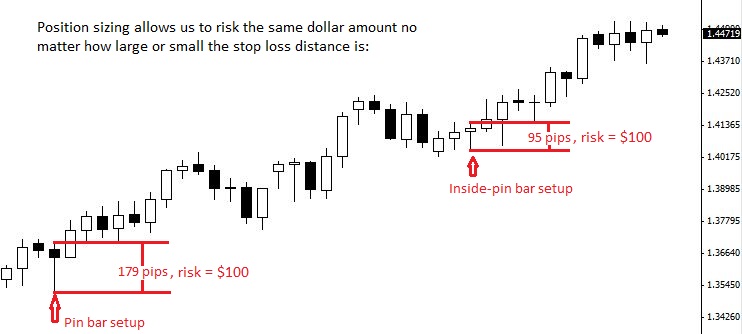
The next important aspect of position sizing that you need to understand, is that it allows you to trade the same $ amount of risk on any trade. For example, just because you have to have a wider stop on a trade doesn’t mean you need to risk more money on it, and just because you can have a smaller stop on a trade does not mean you will risk less money it. You adjust your position size to meet your pre-determined risk amount, no matter how big or small your stop loss is. Many beginning traders get confused by this and think they are risking more with a bigger stop or less with a smaller stop; this is not necessarily the case.
Let’s take a look at the current daily chart of the EURUSD below. We can see two different price action trading setups; a pin bar setup and an inside-pin bar setup. These setups required different stop loss distances, but as we can see in the chart below we still would risk the exact same amount on both trades, thanks to position sizing: