Fixed dollar risk model = A trader predetermines how much money they are comfortable with potentially losing per trade and risks that same amount on every trade until they decide to change their risk.
Fixed percent risk model = A trader picks a percentage of their account to risk per trade (usually 2 or 3%) and sticks with that risk percentage.
In a previous article that I wrote about money management titled “Forex Trading Money Management” – An Eye Opening Article”, I argued that using a fixed dollar amount of risk is superior to the percent of account risk model. The primary argument I make about this topic is that although the % R method will grow an account relatively quickly when a trader hits a series of winners, it actually slows account growth after a trader hits a series of losers, and makes it very difficult to bring the account back up to where it previously stood. This is because with the % R risk model you trade fewer lots as your account value decreases, while this can be good to limit losses, it also essentially puts you in a rut that is very hard to get out of. What is needed is mastery of one’s trading strategy combined with a fixed dollar risk you are comfortable with losing on any given trade, and when you combine these factors with consistent execution of risk / reward, you have an excellent chance at making money over a series of trades.
The % R model essentially induces a trader to ‘lose slowly’ because what tends to happen is that traders begin to think “Since my position size is decreasing on every trade it’s OK if I trade more often”…and whilst they may not specifically think that sentence…it is often what happens. I personally believe the % R model makes traders lazy…it makes them take setups that they otherwise wouldn’t…because they are now risking less money per trade they don’t value that money as much…it’s human nature.
Also, the %R model really serves no real world purpose in professional trading as the account size is arbitrary; meaning the account size does not reflect the true risk profile of each person, nor does it represent their entire net worth. The account size is actually a ‘margin account’ and you only need to deposit enough in an account to cover the margin on positions…so you could have the rest of your trading money in a savings account or in a mutual fund or even precious metals…many professional traders do not keep all of their potential risk capital in their trading account.
The fixed $ risk model makes sense for professional traders who want to derive a real income from their trading; it’s how I trade and it’s how many others I know trade. Pro traders actually withdrawal their profits from their trading account each month, their account then goes back to its “baseline” level.
Example of Fixed $ Risk Vs. % Risk
Let’s take a look at a hypothetical example of 25 trades. We are comparing the fixed $ risk model to a 2% account risk model. Note: We have chosen the 2% risk because it’s a very popular percent risk amount amongst newbie traders and on many other Forex education sites. The fixed $ risk was set at $100 per trade in this example just to show how a trader who is confident in his or her trading skills and trades like a sniper would be able to build his or her account faster than someone settling on a 2% per trade risk. In reality, the fixed $ risk will vary between traders and it’s up to the trader to determine what they are truly OK with losing per trade. For me, if I was trading a small $2,000 account, I would personally be comfortable risking about $100 per trade, so this is what our example below reflects.
It’s quite obvious upon analyzing this series of random trades that the fixed $ model is superior. Sure you will draw your account down a bit quicker when you hit a series of losers with the fixed $ model, but the flip side is that you also build your account much quicker when you hit a series of winners (and recover from draw downs a lot faster). The key is that if you’re really trading like a sniper and you’ve mastered your trading strategy…you’re unlikely to have a lot of losing trades in a row, so the fixed $ risk model will be more beneficial to you.
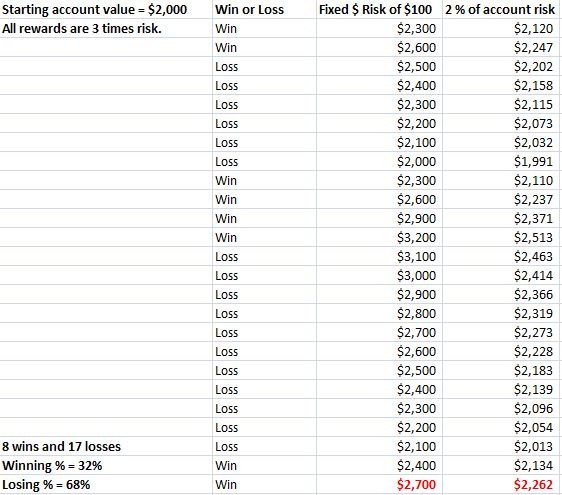
Now this example is a bit extreme, if you are trading with price action trading strategies and have truly mastered them, you shouldn’t be losing 68% of the time; your winning percentage is likely to average close to 50%. You can imagine how much better the results would be with a 50% winning percentage. If you won 50% of the time over 25 trades while risking $100 on a $2,000 account, you would have $4,500. If you won 50% of the time over 25 trades while risking 2% of $2,000, you would have only about $3,300.
Many professional traders use the fixed dollar risk method because they know that they have mastered their forex trading strategy, they don’t over-trade, and they don’t over-leverage, so they can safely risk a set amount they are comfortable with losing on any trade.
People who trade the %R model are more likely to over-trade and think that because their dollar risk per trade is decreasing with each loser it’s OK to trade more trades (and thus they lose more trades because they are taking lower-probability trades)…and then over time this over-trading puts them much further behind a fixed $ trader who is probably more cautious and sniper- like.
Conclusion
To succeed at trading the Forex markets, you need to not only thoroughly understand risk reward, position sizing, and risk amount per trade, you also need to consistently execute each of these aspects of money management in combination with a highly effective yet simple to understand trading strategy like price action.